



2026 so far: A mid-year market review
In February, we released an article detailing our predictions for markets in 2026. In it, we expected four key themes to emerge:
- AI investment would increase.
- Geopolitical tensions would cause periods of volatility.
- Bull markets would continue.
- Gold and silver would rise in value.
Six months later, markets have broadly followed our predictions.
The Guardian reported that since January, the AI Winners Index (which tracks 45 US companies considered to be at the forefront of the AI industry) has grown by just under 60%.
The onset of the Iran war has led to sustained economic turbulence. Despite this uncertainty, global markets have continued their bull run.
Gold and silver valuations fluctuated more than expected in 2026. While gold prices peaked at £4,068.11 an ounce on 2 March, they fell to as low as £2,959.35 an ounce on 17 July, according to Royal Mint data.
In this article, we provide deeper insight into market behaviour in 2026, paying particular attention to equity markets, inflation, and bonds. We also look ahead to what the coming months might hold for you and your financial plan.
The Middle East conflict continues to affect markets
The conflict in the Middle East has lasted for more than four months, and it’s important that we first acknowledge the considerable risk to civilian life that the war is posing within the region.
Ceasefire discussions have been tumultuous, with agreements made and broken several times.
Most recently, a breakdown in negotiations caused the US blockade of the Strait of Hormuz to resume. The Guardian reported that the price of Brent crude oil, which was levelling off, rose above $100 a barrel on 23 July.
However, it’s worth mentioning that prices are nowhere near the highs of $126 a barrel reached on 30 April, according to CNN Business data.
Higher oil prices are having a direct impact on UK households – the BBC reports that annual gas and electricity bills will rise to £1,862 a year. It is worth mentioning that since Andy Burnham replaced Keir Starmer as the British prime minister, he has announced several policies to ease cost of living and energy pressures (more on this later).
Equity markets are showing promise despite uncertainty
While the conflict is ongoing, it is not causing the same degree of volatility as when the war first began on 28 February.
In fact, according to Yahoo Finance, the S&P 500 index has steadily risen in value by nearly 19% from 30 March to 14 July (see graph below).
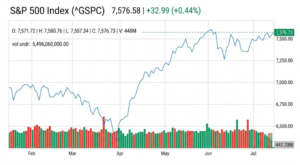
Likewise, according to the London Stock Exchange (LSE), the FTSE All-Share Index has also shown signs of recovery, although less so than the S&P 500.
JP Morgan reports that this bull market is being driven by rising investment in AI, supported by improved labour markets. While geopolitical tensions aren’t expected to go away in 2026, growth is simultaneously expected to buoy markets.
Signs are positive, but uncertainty remains high. That’s why it’s more important than ever to reach out to your Caliber financial adviser before you make any decisions about your portfolio. Otherwise, a knee-jerk reaction might harm your future objectives.
UK inflation has stabilised, but the future looks precarious
Inflation – the rise in the price of goods and services – can have a significant impact on personal finances. When inflation is high, it can reduce individual spending power.
As we explained earlier, the Middle East conflict and the blockade of the strait of Hormuz have caused the price of oil and gas to rise, making petrol and energy bills more expensive.
Despite this rise, inflation in the UK has recently stabilised.
The Consumer Prices Index (CPI) – the measure of UK inflation – rose to 3.3% in the year to March 2026 following the outbreak of the Iran war. However, the rate has since reduced to 2.6%.
This is largely due to lower food prices offsetting inflation, which the BBC reports fell from 3% in the year to April to 2.2% in the year to May.
Experts predict that food inflation is likely to rise in the coming months, as the delayed effects of the Iran war impact the costs paid by farmers, processors, and manufacturers.
This means UK inflation could increase. However, this is largely dependent on the outcome of the Middle East conflict.
Andy Burnham’s leadership may also impact inflation. Since he took office on 20 July, he has announced several policies aiming to ease the cost of living, including cuts to VAT on electricity and a return to the previous £2 cap on bus fares.
Bond market volatility is likely to last
Bonds are different from stocks and shares. Rather than owning a portion of a company, a bond acts as a loan. In return, the issuer promises to pay you regular interest, or “yields”, before paying back the original amount.
These are normally perceived as “safer” investments and are issued by governments or companies.
Bond markets have seen notable volatility in the first half of 2026. According to Bloomberg (representative of the global bond market), bonds sharply declined following the outbreak of war in the Middle East, before enduring a period of sustained peaks and troughs.
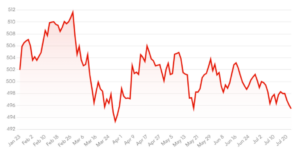
The story at home is different.
The recent change in prime ministers has restored a degree of confidence in UK politics; Morningstar reports that yields on 10-year UK government bonds rose above 5% on 20 July.
However, this stability in UK bond yields may not last.
Interest rates have an inverse relationship with bonds – when interest rates rise, the price of bonds typically falls.
The Bank of England (BoE) base rate – which influences wider interest rates – is now fixed at 3.75%. However, renewed hostilities in the Middle East make it more likely that these rates will rise in the future, meaning the bond markets could experience volatility in the coming months.
Weather the storm with your Caliber financial adviser
2026 so far proves that no one can guess the future with 100% accuracy.
While geopolitical problems were anticipated, the events of the Iran war have often been unpredictable, creating a period of prolonged uncertainty.
As we emphasised in our previous piece – the importance of staying calm as the Middle East crisis continues – it’s vital that you weather uncertainty with a cool head. History tells us that volatility is a natural part of investing, and markets are likely to recover given time.
If you’d like reassurance about your portfolio, reach out to your Caliber financial adviser today.
Email contact@caliberfm.co.uk or call 01525 375286.
Please note
This article is for general information only and does not constitute advice. The information is aimed at individuals only.
All information is correct at the time of writing and is subject to change in the future.
The value of your investments (and any income from them) can go down as well as up and you may not get back the full amount you invested. Past performance is not a reliable indicator of future performance.
Investments should be considered over the longer term and should fit in with your overall attitude to risk and financial circumstances.